What Does an App Cost? A Practical Budget Guide 2026
What does an app cost? This budget guide explains the cost factors, shows honest price ranges from over 10 years of agency practice and helps you plan your budget realistically.

What does an app cost? This budget guide explains the cost factors, shows honest price ranges from over 10 years of agency practice and helps you plan your budget realistically.
If you want to know how much an app costs, you will hear the same answer almost everywhere: "It depends." That is even true. It just does not help you plan your budget at all. The honest answer is: it depends, and we will tell you exactly what it depends on.
In more than 10 years of app development we have guided projects from small MVPs to company-wide platforms, for clients such as Flaschenpost, CLAAS and DHL among others. Time and again we see the same situation: companies want an app but have no solid idea of what is realistic. 20,000 euros? 200,000 euros? Both can be right, depending on what you have in mind.
This guide breaks with the tradition of vague answers. You get concrete price ranges, the most important cost factors and the hidden items that are missing from almost every quote. We also show you how to plan your budget so that no nasty surprises are waiting for you at the end. The goal is not to sell you something, but to give you a realistic estimate you can work with, no matter which agency you ultimately choose.
This guide is your entry point: it explains how app prices come together and how to size your budget realistically. As soon as it comes to the concrete calculation for your project, our app development cost page is the right place to go. But first, let us understand what actually determines the price.
The cost of app development in Germany ranges roughly between 15,000 and 250,000 euros depending on scope. Where your project lands within that range comes down to seven factors above all. Once you understand them, you can judge almost any quote better.
1. Complexity and feature set. This is by far the biggest lever. An app that mainly displays content is many times cheaper than an app with user accounts, real-time sync, payment, offline mode and custom business logic. Every feature means concept, development, testing and later maintenance. The rule of thumb: it is not the first idea that costs money, it is the many edge cases hidden behind it.
2. Platform: iOS, Android or both. Do you want to reach only iPhone users, only Android, or both? Two separately developed native apps nearly double the development effort. This is exactly where cross-platform development comes in, more on that in the direct cost comparison below.
3. Design ambition. A solid standard design based on proven components is noticeably cheaper than a fully custom UI/UX concept with its own visual language, animations and branding. Good design is not just looks, it decides whether your users enjoy using the app. You can see how much impact lives here on our page about professional app design.
4. Backend and infrastructure. Many underestimate that the visible app is often just the tip of the iceberg. As soon as data is stored centrally, users are managed or other systems are connected, you need a backend in the cloud, for example on Azure. Every interface to an existing system such as an ERP, an inventory system or a CRM costs additional effort.
5. Maintenance and further development. The item that is simply missing from most calculations. An app is not a product you build once and then leave alone. Operating systems are updated every year, libraries age, and your users want new features. There is a dedicated section on this below.
6. Security and liability. Especially in B2B and industrial settings, GDPR compliance, encryption, secure authentication and audit-proof data storage play a big role. These requirements are important and right, but they also increase the effort. And they have a flip side that many underestimate: whoever runs business-critical software also carries the responsibility when it fails. Why this may be the single most important cost factor is something we look at more closely further down.
7. Project management and communication. Running a project cleanly, aligning regularly and documenting properly takes time. That time is well invested, because poor communication is one of the most common reasons for failed and therefore expensive projects. Serious providers state this share openly instead of hiding it.
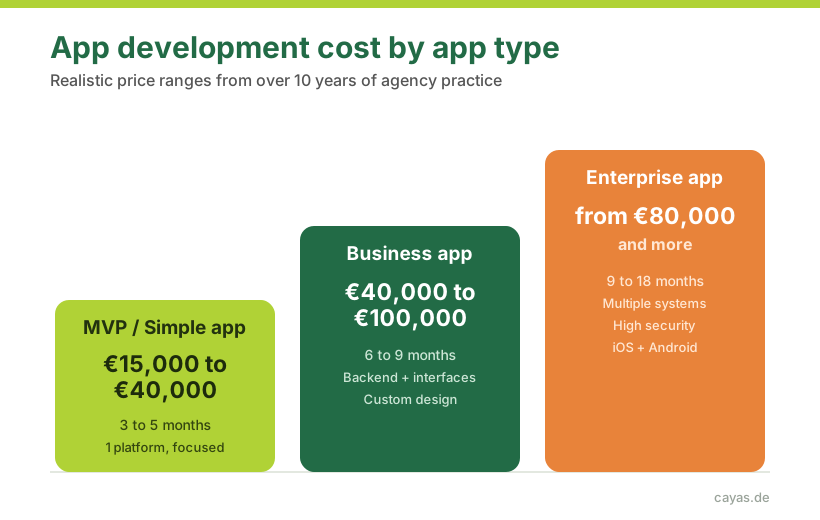
Now to the numbers you have probably been waiting for. The ranges below are based on real projects from our agency practice. They are deliberately given as ranges, because any serious fixed price only emerges after a close look at your requirements.
| App type | Realistic cost | Typical duration |
|---|---|---|
| Simple app / MVP (1 platform) | 15,000 to 40,000 euros | 3 to 5 months |
| Mid-complexity business app | 40,000 to 100,000 euros | 6 to 9 months |
| Enterprise app with backend | 80,000 to 250,000 euros and more | 9 to 18 months |
Simple app or MVP (15,000 to 40,000 euros). This is about a focused app with one clear job, for example a digital form for field staff, a product catalog app or the first version of an idea you want to test on the market. It includes concept, a clean design, development for one platform and publishing to the store. It does not include elaborate backends, many third-party systems or sophisticated special features.
Mid-complexity business app (40,000 to 100,000 euros). This is the typical range for apps that really map processes inside a company. That includes user management, a backend in the cloud, one or two interfaces to existing systems and a custom design. A typical project for us looks like this: an app for service technicians who process jobs offline, document them with photos and sync everything as soon as there is a connection again. Such projects usually land in the middle of this range.
Enterprise app with backend (from 80,000 euros). As soon as multiple user groups, complex business logic, several system integrations, high security requirements and both platforms come together, you are in this category. Apps like the solutions we have built for large clients fall under this. The range is open at the top, because what often emerges here is a whole ecosystem of app, backend and connected services.
You can best see the breadth of projects behind this in our reference projects. And if you already have a concrete idea and want to have an app developed, one thing pays off at the start above all: being honest about what truly belongs in the first version.
To make the numbers more tangible, here is a typical example from our daily work. Take a mid-complexity business app for 60,000 euros. This is roughly how the budget is split across the individual project phases:
| Project phase | Share | Example cost |
|---|---|---|
| Concept and requirements analysis | 10 % | 6,000 euros |
| UI/UX design | 15 % | 9,000 euros |
| App development | 35 % | 21,000 euros |
| Backend and interfaces | 25 % | 15,000 euros |
| Testing and quality assurance | 10 % | 6,000 euros |
| Project management and launch | 5 % | 3,000 euros |
What stands out is that the pure app development makes up only about a third of the budget. The large rest goes into concept, design, backend, testing and steering. That is exactly what is often underestimated: whoever pays only for the visible part of the app gets only that in the end. The phases before and after decide whether the app really works in everyday use and whether it stays secure and maintainable. This split is not a fixed law but an orientation. For very design-heavy apps the design share grows, for data-driven apps the backend share.
What would your app cost?
The ranges above are real-world figures. What your specific project costs is something we can tell you best in person. In a free initial consultation we look at your idea together and give you a realistic estimate. No obligation, no sales pressure.
Get your free consultation
How your app is built technically says less about the price than about quality, maintainability and the responsibility behind it. This is where our specialty comes in, because as a former Xamarin Premier Partner and today a .NET MAUI expert we see every day what really matters in this decision.
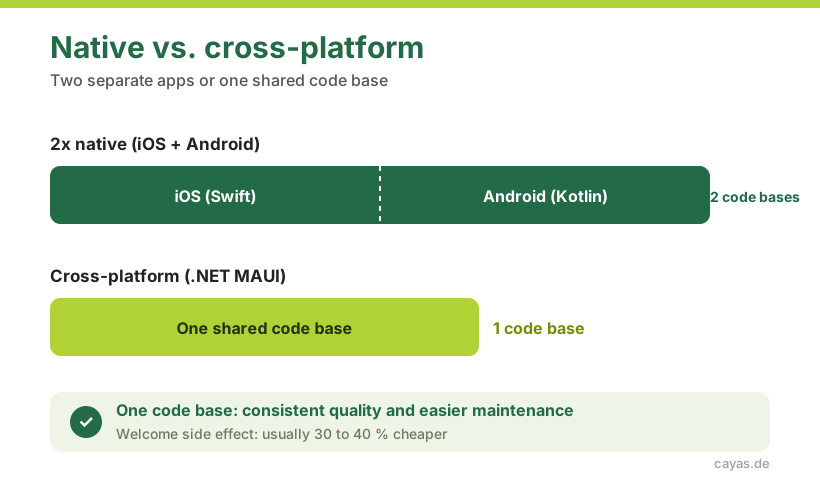
With native development, a separate app is built for each platform: one for iOS in Swift and a separate one for Android in Kotlin. The result is technically first-class, but it means two separate code bases and two teams that have to be kept in sync permanently.
With cross-platform development using .NET MAUI, we write most of the code once and ship the app to iOS and Android at the same time. The real advantage is not the price, it is consistency: one shared code base means identical behavior on both platforms, fewer places where bugs can arise, faster fixes and one team that is responsible for the whole. That costs usually drop too is a welcome side effect, not the reason.
| Criterion | 2x native (iOS + Android) | Cross-platform (.NET MAUI) |
|---|---|---|
| Code base | two separate | one shared |
| Behavior on iOS and Android | can drift apart | consistent |
| Maintenance and bug fixing | maintain two apps | maintain one code base |
| Responsibility | two teams | one team |
| Effort and cost | higher | usually 30 to 40 % lower |
| Ideal for | graphics and hardware-near apps | business and process apps |
Does that mean native development is obsolete? No. If your app relies heavily on platform-specific features, such as elaborate 3D graphics, hardware-near sensors or a game with the highest performance demands, native development can be the better choice. For the large majority of B2B and business apps that digitize processes, cross-platform development with .NET MAUI is usually the smarter path: one shared code base that you maintain and evolve reliably over years. That it is also cheaper in the long run comes on top.
Here it gets honest, because this section is missing from almost every quote. The development cost is only part of the truth. Anyone planning long-term has to know the ongoing costs too. Otherwise a well-calculated project turns into an unpleasant surprise after a year.
Maintenance and further development. The most important number to remember: plan 15 to 20 percent of the original development cost per year for maintenance. For an app that cost 80,000 euros, that is 12,000 to 16,000 euros a year. This covers bug fixes, closing security gaps and smaller improvements.
Forced updates from new operating systems. Apple and Google release new versions of iOS and Android every year. To keep your app running reliably and staying in the stores, it has to be adapted regularly. This effort arises whether or not you want new features.
Server and cloud costs. As soon as your app uses a backend, ongoing costs for hosting, database and data traffic apply. Depending on the number of users, that ranges from a few euros to four-figure amounts per month.
Store fees. For publishing you currently pay Apple around 99 euros per year and Google a one-time fee of around 25 euros. Small items, but they belong in an honest calculation.
Third parties and licenses. Maps, push notifications, analytics tools or payment providers often charge monthly fees that grow with usage.
| Hidden item | Order of magnitude |
|---|---|
| Maintenance and further development | 15 to 20 % of development cost per year |
| Apple Developer Program | around 99 euros per year |
| Google Play Developer | one-time around 25 euros |
| Server and cloud | from a few euros to four-figure per month |
| Third-party services | depending on usage, often monthly |
What we advise our clients: factor in the ongoing costs from the start and do not treat them as an annoying side issue, but as an investment in an app that stays reliable. A neglected app loses users quickly, and that is more expensive in the end than any maintenance.
Before you think about the exact price, another decision is worth making: who should actually build your app? There are three common routes, and they differ not only in price but above all in risk.
| Model | Typical cost | Strengths | What to watch out for |
|---|---|---|---|
| Freelancer | lowest hourly rate | cheap, flexible for small projects | bottleneck if they are unavailable, rarely design, backend and testing from one source |
| Agency | 100 to 150 euros per hour | well-coordinated team, experience, reliability, cover secured | higher day rate, pays off from mid-size projects on |
| In-house team | high ongoing fixed costs | full control, knowledge stays in the company | expensive to build, hard to staff and retain |
A single freelancer can be a very good and cheap choice for a first, small version. For an app that carries important processes inside a company, the concentration risk quickly becomes a problem: if that one person drops out, the whole project stalls. An agency, by contrast, bundles concept, design, development and testing into one well-coordinated team and secures cover. An in-house team only pays off once you develop software permanently and at scale, because good app developers are expensive and hard to find.
In practice, most mid-sized companies choose an agency and flexibly add external specialists when needed. For exactly these situations we offer the Expert-as-a-Service model, where you bring in the missing know-how in a targeted way without having to build a whole team.
The same maths applies beyond apps, by the way. If what you actually need is a business application, a backend or an interface, the price ranges and decision criteria for custom software are set out on their own page.
With the knowledge about cost factors and hidden items, you can now put together a budget that holds. We give these five recommendations to most of our clients.
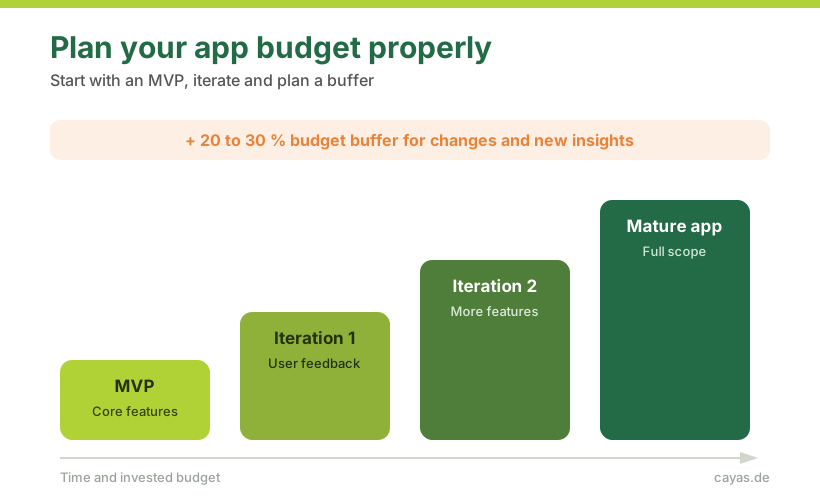
Start with an MVP, then iterate. Do not try to cover everything in the first version. Build a first version with the most important features, get it to real users early and develop it further based on their feedback. That way you put your money into what is actually used, instead of features nobody needs.
Plan a buffer. No matter how good the concept, it never fully survives first contact with reality. Plan a buffer of 20 to 30 percent for changes, new insights and wishes that only emerge during the project.
Fixed price or time and material? With a fixed price you agree on a clearly defined scope for a fixed price. That gives planning certainty but requires a very precise concept. With time and material you bill by actual effort. That is more flexible when requirements are still evolving, but it demands trust and close coordination. In practice, a mix often works best: a fixed price for a clearly defined first version and flexible billing for the further development.
Know the hourly rates. Established app agencies in Germany and Western Europe usually work with hourly rates between 100 and 150 euros. Offers with rates below 60 euros often come from offshore providers. That can fit, but it frequently means extra effort for communication, time-zone gaps, quality assurance and rework. The lower hourly rate then often leads to higher total costs.
How to recognize a serious agency. A good agency asks about your goal first, not your budget. It gives you realistic ranges instead of wishful prices, explains hidden costs on its own initiative, shows you comparable references and sometimes even advises against a feature. If an offer is strikingly cheap and fulfills every wish without hesitation, healthy skepticism is in order.
And the most honest question to close this section: does an app even pay off for you? An app pays off when it improves a clear process, measurably saves you time or money, or gives your customers real added value. If you can answer that question clearly, the budget is well invested. If not, even the cheapest app will not help you.
A common misconception is that app development now costs almost nothing thanks to AI. The truth is: AI-assisted tools noticeably speed up many routine tasks in development, for example writing standard code or testing. That lowers the effort in some places.
At the same time, expectations rise elsewhere. Users today are used to high-quality apps and barely forgive a mediocre design. Requirements for data protection under GDPR, for accessibility and for security keep growing. And the shortage of skilled people means that experienced app developers tend to get more expensive rather than cheaper. On balance, the price ranges in this guide stay realistic for 2026. What shifts is the weighting: a larger part of your budget flows into concept, design and quality, that is, into exactly the things AI does not take off your hands and that decide the success or failure of your app.
With all the numbers above, many people overlook the question that actually matters. It is not "What does building the app cost?", but "What does it cost when the app fails, and who answers for it then?"
Imagine your app runs order processing in the field, picking in the warehouse or access to sensitive data. If it goes down, returns wrong results or leaks data, we are no longer talking about a few thousand euros of development cost. We are talking about stalled processes, contractual penalties, lost orders, possible data protection violations and damaged trust. These follow-on costs quickly exceed the original development price many times over.
On top of that comes a point many do not have on their radar yet: the EU has modernized its product liability and now explicitly includes software. A defective piece of software can therefore trigger liability claims, much like a defective physical product. The question "Who is liable when something goes wrong?" is no longer theoretical.
This is exactly the honest answer to the thought "We will just build it ourselves, with AI if needed." AI can generate code. But it takes on no responsibility, no testing strategy, no clean documentation and, above all, no liability. Whoever assembles business-critical software themselves or has it built by the cheapest provider carries the full risk alone. An experienced agency does not just build the app, it answers for it with traceable processes, tested quality, clean documentation and a dedicated contact.
Seen this way, the development price is not the real cost factor. It is an insurance against exactly the failures that could cost you many times more later.
Let us sum up. A simple app starts at around 15,000 euros, a mid-complexity business app typically lands between 40,000 and 100,000 euros, and a large enterprise solution starts at 80,000 euros and can go well beyond. Where your project lands depends on feature set, platform, design, backend, security and maintenance. A shared code base built on .NET MAUI makes the app easier to maintain in the long run and usually cheaper too, and the ongoing costs of 15 to 20 percent per year belong in your plan from the start. In the end, though, the biggest item is rarely the build itself, it is the risk when a business-critical app does not run reliably.
What your app will cost specifically can only be said seriously once we know your project. That is exactly what we are here for. In a free initial consultation we look at your idea together, classify it honestly and give you a realistic range you can keep planning with. Entirely without sales pressure.
When you want to move from understanding to calculating, our app development cost page gives you the concrete cost breakdown for your project. And once you are ready to turn your idea into reality, let us talk about your project.
Ready to turn your app idea into reality?
From the first idea to the app store, our team guides you through the entire project, honestly calculated and transparently planned. Let us find out together what the right path is for you.
Have an app developed
A simple app or MVP for one platform usually costs between 15,000 and 40,000 euros at a German agency. That includes concept, design, development and publishing to the store. The more custom features and integrations you add, the higher the price.
Plan for 15 to 20 percent of the development cost per year for maintenance and further development. For an app that cost 80,000 euros, that is around 12,000 to 16,000 euros a year, or roughly 1,000 to 1,350 euros a month. Server and cloud costs plus the store fees come on top.
Yes, usually by 30 to 40 percent at a comparable feature set. More important than the price, though, is that a shared code base built on .NET MAUI behaves consistently on both platforms and is easier to maintain in the long run. Native development mainly pays off for highly graphics-heavy or hardware-near apps.
An MVP is usually usable within 3 to 5 months. A mid-complexity business app takes 6 to 9 months, and a large enterprise app with a backend 9 to 18 months. The timeline depends heavily on the feature set and the number of connected systems.
For a professional B2B business app you should plan for at least 40,000 euros. Typical projects with a backend, interfaces and a well thought-out design land between 60,000 and 120,000 euros. Add a buffer of 20 to 30 percent for changes.
Yes, and that is exactly what we recommend to most clients. You start with an MVP that covers the most important features, put it to use early and develop it further based on real user feedback. That way you spend the budget wisely and avoid expensive mistakes.
Established app agencies in Germany and Western Europe usually work with hourly rates between 100 and 150 euros. Very cheap offers below 60 euros per hour often come from offshore providers and frequently mean extra effort for communication, quality assurance and rework.

As a mobile enthusiast and managing director of Cayas Software GmbH, it is very important to me to support my team and our customers in discovering new potential and growing together. Here I mainly write about the development of Android and iOS apps with Xamarin and .NET MAUI.
Flutter or React Native? Most comparisons stop at two frameworks and leave out the third strong option. This guide compares Flutter, React Native and .NET MAUI against the criteria that actually matter to decision makers: cost, maintainability, team availability and long-term viability.
Want to have an app developed but not sure where to start? This guide walks you through the process, the choice between agency, freelancer and offshore, the right briefing and all the questions you should answer before you begin.